-->
i’ve worshiped with a lot of different faith communities over my lifetime,
starting here at grace church. i’ve experienced everything from very high
church settings in orthodox traditions to powerful music-driven rock band services
to extremely laid back emergent church in the round atmospheres. i’ve been a
part of churches with less than 15 regular attendees to experiencing worship with
13,000. i’m certain i haven’t seen it all, but i sure have seen a lot of different
kinds of churches.
that happens when you move around a lot. you find yourself searching for
a church in your new community. you find yourself searching for a new place to
call home.
i know people who have this church search business down to a science.
they want a church in a convenient location with a talented praise band and a
powerful preacher. oh, and we can’t forget an active children’s ministry where
they can drop off the kids at least twice a week and know that they’ll make friends
and have a good time.
these are good things to pay attention to when looking for a church
community, important things, …but i would say that they are missing the point if
that’s all they’re looking for.
because church isn’t about a convenient location or the quality or genre
of music.
it’s about what we believe in. about who we believe in. about why we
celebrate Christmas and easter. it’s about a God who breathed a son into being
who changed the world through three short years of ministry, calling us to love
one another then died so that as a forgiven people we just might get it right
one day.
the church is about the greatest commandment – to love God with our
whole beings and to love our neighbors as ourselves. the church is about community
– with our Creator and with creation.
the church is about feeding the hungry, clothing the naked, and freeing
the oppressed. it’s about speaking up for the marginalized in our society and
peacefully, yet boldly fighting for justice.
our scripture today may come from the minor prophets, but i believe it articulates
very simply what Jesus spent his life trying to teach us.
what does the Lord require of you? does God care about the genre of music
or the amount of fancy technology used in a service? does God care about how
we’re dressed for worship or what banners we have hanging in the halls of our
churches?
i don’t think so.
and i believe that’s what God was getting at when speaking through the
prophet micah. the rituals, the pomp and circumstance, the sacrifices and the
grand gestures meant nothing to God unless the people really felt it in their
hearts, and based on the story that precedes the verses of our scripture
lesson, well, it sounds like israel wasn’t quite keeping up with that part of
the covenant.
what does the Lord require of you? God doesn’t want empty gifts. God
wants our hearts. and God wants action.
what does the Lord require of you? to act justly, to love mercy and to
walk humbly with your God.
one of the strongest role models we have in this endeavor is the united
methodist women.
now, i have attended mother’s day banquets and hymn sings hosted by united
methodist women. i’ve donated to rummage sales and even spent three hours straight
making vats of tea for a southern umw high tea party, and i spent a lot of
years not truly understanding what it meant to be a united methodist woman. i didn’t realize where the money was going.
for example, did you know that in the past year the united methodist
women here at grace have raised around $16,000 and given that money to organizations
like habitat for humanity, africa university, side by side family mentoring,
frances meredith homeless shelter, the camping and outreach funds and so much
more listed in your bulletin.
when i think of united methodist women, i think of women’s societies in
the church traditions long ago who would eventually merge together to form the
united methodist church. i think of the women in north carolina who started children’s
missionary societies in the 1870s. i think of the women who began fighting for
racial justice in the 1880s.
i think of the women’s missionary council who were extremely vocal about
all kinds of national legislation in the 1940s like fighting for a repeal of
the chinese exclusion act or supporting the extension of social security
coverage to domestic and agricultural workers.
i think of 1954, when the woman’s division was the first agency of the
methodist church to issue a statement in support of the supreme court’s decision
that segregation in public education anywhere in this nation is an infringement
of the constitution and a violation of the fourteenth amendment.
i think of 1960, when, out of support for the declaration of human rights,
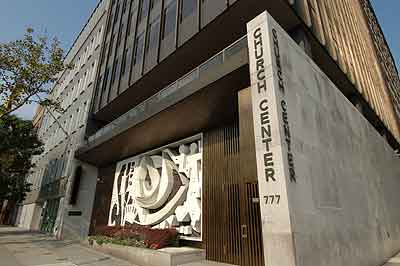
the women’s division led the way in purchasing property of what would become
the church center for the united nations, directly across the street from the
united nations complex so the methodist church could take part in affecting decisions
for similar important causes. the church center continues to be the closest faith-based
property to the united nations.
i remember visiting that building while i was in college, but more vividly
remembered are the days i spent there just a few years ago as part of a summit
on global health. i was working for pfeiffer university at the time, and as a
school founded by a predecessor of the united methodist women and included in
the umw higher education initiative, we were invited to new york to participate
in a summit on world health issues.
nine schools were represented at the summit. there were maybe a couple dozen of
us in attendance and we spent several days sitting around a conference table
learning about things like the need for proper midwifery training in africa and
the need for clean water wells in uganda.
we dove into studies linking poverty and poor health in our own communities
here in america and about what our government was discussing at the time to
solve those issues. then we spent as many days discussing how we might leverage
our influence with college students to spread the word and make change happen.
who hosted that summit? the women’s division of the general board of global missions.
the united methodist women.
not only does the united methodist church own the closest faith-based
property to the united nations in new york city, we also own the closest faith-based
property to this nation’s capitol in washington dc. visiting this building was
my first real experience with the global church. i was nineteen. i was young. i
grew up in a small town, then went to college in an even smaller town in rural
west virginia.
sure, i knew something about rural poverty issues but i knew next to
nothing about social justice issues effecting the rest of the world. heck, i quickly
learned that i knew next to nothing about the social justice issues within my
own community.
those few days during that seminar in dc changed the way i saw the
world. before that, i had never heard of a carbon footprint and had no idea
that human trafficking even existed. woven throughout learning about all of
these issues, we also learned about systemic injustice and the legislation that
either works to eradicate or sadly to prolong these community issues.
the most uncomfortable and equally incredible part of the seminar
program, though, was when susan, the seminar program director, handed out paper
and pens and led us in writing to our state representatives to demand justice.
i had spent many years going on mission trips, collecting canned goods,
donating clothing and all kinds of other charitable acts. never before had i
thought about the idea that there may be laws out there that are keeping people
in poverty. never before had i thought about writing to congress or signing petitions
or marching to the capitol – all things that the united methodist women are involved
with on a regular basis.
when i took college students from pfeiffer to experience the same seminar
program just a few years ago, susan took that activity a step further and
showcased the very reason the united methodist church thought it was important
to own land on capitol hill when they picked it out in 1917.
we walked across the street and met with our congresswoman. students
shared about what they were passionate about. they respectfully asked her to
keep their stories and opinions in mind when it came time for her to vote and
represent them as citizens of her state. that remains one of my favorite
moments as a Christian educator.
when i think of united methodist women, i think of that seminar program
and that united methodist building on capitol hill. i think of mrs. wilson, who
drew the original plans for the building whose lobby walls are engraved with
the scripture “what does the Lord require of you but to act justly, to love
mercy and to walk humbly with your God.”
when i think of united methodist women i think of these life-changing
experiences throughout my journey. from global initiatives like seminars at the
church center or the united methodist building to conference-wide initiatives like
camping ministry and the summers i spent at camps wanake, asbury and
aldersgate, to incredibly personal connections with united methodist women here
at grace who taught me to play piano, taught me sign language, led sunday school
and youth group and taught me what it meant to be a Christian. these moments,
and so many more, have influenced me in magnificent ways.
as i’ve moved around throughout my life, finding new churches to call
home in each new city i’ve seen a lot of different types of communities but one
thing has been consistent. in every church community i find the united methodist
women humbly serving their church and actively seeking justice in their community.
i am proud to be a woman of the united methodist church, and every day i
strive to live up to the legacy the umw continues to leave in our churches and in
the world. what does the Lord require of you? ask a united methodist woman. i
bet she’ll be able to show you.