"man, when he does not grieve, hardly exists." ~ antonio porchia
i struggle with grief. i'm not good at mourning. in an attempt to appear as though i've got it all together, i let the fear and the hurt and the frustration build up until all of a sudden i can no longer function. i freeze. i let the pain overpower me.
unfortunately, my christian tradition didn't give me much to work with when it comes to grieving. our jewish brothers and sisters, however, have a rich language for mourning and i have found it exponentially helpful in times like these.
the first phase is called aninut, or "burial" which lasts between death and burial. during aninut mourners are free from all responsibility. they don't have to do anything but prepare for the funeral. rabbi margaret holub says "mourners are exempt from other commandments during aninut because only the living are obligated by God's law, and in those first days after a death, mourners border on death themselves." more than that, even the community is free from obligation. they aren't supposed to visit or bring food or even try to comfort the mourners. as rabbi holub says, "the death is still happening, so the work of comforting cannot yet begin."
the second phase is called shiva, or "seven" for the first week following the burial. the community gathers at the mourner's home to "sit shiva". in silence, they sit. during this time, the mourners do not leave the house, but rely on the community to bring meals and offer support without offering advice. this is taken from the story of job and it is my favorite part of the jewish mourning process.
the third phase is called shloshim, or "thirty" and lasts for the next month. finally, the mourner comes out of their house and enters society once more. it is a gradual process, of attending services and talking with friends.
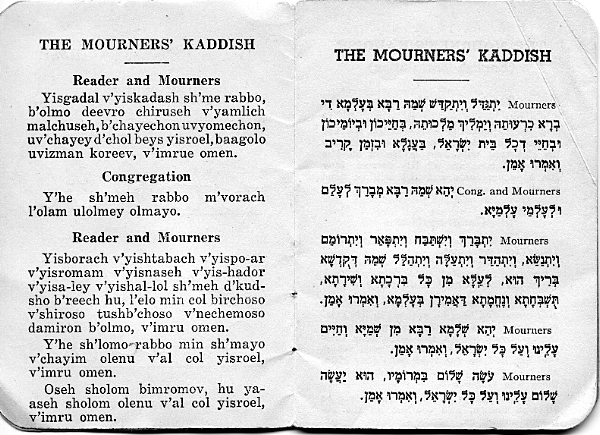
finally, after the thirty days, the mourner enters the final phase of mourning which last a full year. during this time you pray the kaddish, but you can't pray it alone. by design, you must pray this prayer with a community. it forces the mourner back into the community. you actually say the kaddish twice a day, every day for the the full year after the death, including during shiva and shloshim.
the kaddish is a reminder of who God is and how God is working in our lives. and even if you don't feel like praying, you do it. kind of a 'fake it til ya make it' attitude. you pray the kaddish because you know that even if you don't feel it in that moment, God is there.
 in her book mudhouse sabbath, lauren winner says it this way: "even in the pit, even in depression and loss and nonsense, still we respond to God with praise. this is not to say that the mourner should not feel what he feels - anger disbelief, hatred. he can feel those things (and shout them out to God; God can take it.). you do not have to feel praise in the intense moments of mourning, but the praise is still true, and insisting upon it over and over, twice a day every day, ensures that eventually you will come to remember the truth of those praises."
this is the part i forget, sometimes. i forget to praise God through the pain. i forget that even though i just can't feel it, that God is there and that God is still mighty and powerful and loving and just. that even though all i may be able to see is the darkness and the pain and the doubt, that God is still God.
i love this process. because it is just that - a process. i think sometimes as christians we talk about grief and we talk about moving forward but we don't do a good job of teaching what happens in between. we bring meals and we send cards, but that typically only lasts a couple weeks or so. after that, the cards stop coming and the doorbell stops ringing. after that, we're all alone. it's expected that we should move on with our lives.
the jewish tradition recognizes the need for a longer mourning process. it recognizes that we don't move on so quickly. sometimes things never go back to normal. most times, you have to create a new normal, and that takes time.
tonight, i sit shiva. tonight, i sit in silence as others grieve. tonight, i pray with them the kaddish, because God is still there. amidst the pain and the confusion and even the hatred, God is still there. and God is still God.
may the great name of God be exalted and sanctified,
throughout the world, which he has created according to his will.
may his kingship be established in your lifetime and in your days,
and in the lifetime of the entire household of israel,
swiftly and in the near future;
and say, amen.
may his great name be blessed, forever and ever.
blessed, praised, glorified, exalted, extolled,
honored elevated and lauded be the name of the holy one,
blessed is he - above and beyond any blessings and hymns,
praises and consolations which are uttered in the world;
and say, amen.
may there be abundant peace from heaven,
and life, upon us and upon all israel;
and say, amen.
he who makes peace in his heights, may he make peace,
upon us and upon all israel.
and say, amen.

No comments:
Post a Comment